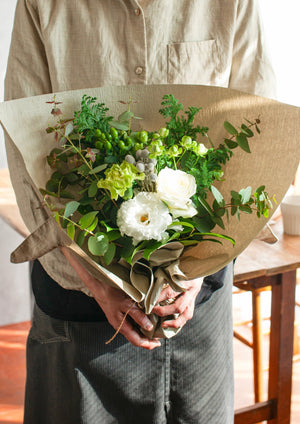
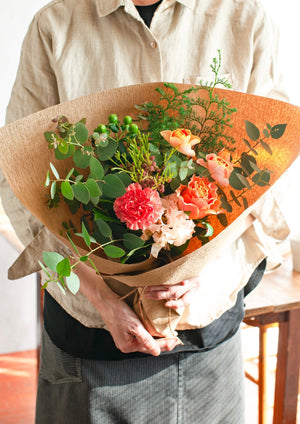
Learn about Hypericum flower meanings and history!

Learn about the flower language and history of Hypericum!
Are you familiar with the plant Hypericum?
Even if you haven't heard the name, if you frequently receive flower gifts, you might think, "Oh, this is it!" because it's a very common filler. While it's rarely the main star of a floral gift, more of a "behind-the-scenes hero", it's actually a profound plant that has been closely intertwined with human history.
This time, we will introduce Hypericum in detail, from its flower language to its history. We hope you find it useful when choosing a gift.
What kind of plant is Hypericum?

| Botanical Name | Hypericum |
| Scientific Name | Hypericum |
| Family | Hypericaceae |
| Genus | Hypericum |
| Origin | Europe |
| Blooming Season | June - July |
Hypericum is a plant with over 400 species worldwide, and it also grows wild in Japan.
Its colorful, glossy, and cute berries are the main reason it's often seen as a filler, but its flowers are also beautiful and vibrant yellow. Many people might feel like they've "seen it before!" because it's frequently used in flower arrangements and bouquets.
Hypericum is also a medicinal herb that has been used globally since ancient times, making it a plant deeply intertwined with human history.
What is the origin of the name Hypericum?

Hypericum is derived from the Greek words "hyper" (above) and "eikon" (image, spirit, ghost).
This means "placed above spirits" = "to ward off evil spirits." The reason for this name is that Hypericum flowers and leaves have been used as a charm against evil since ancient times.
It was believed that hanging Hypericum at the entrance of a house would protect against evil spirits and bad luck. Additionally, since it had the effect of improving symptoms of "mental illness" when taken as a medicinal herb, it was highly valued as an "amulet to ward off evil spirits" in times when the line between occult and medicine was blurred.
In English, it's "St. John's Wort"

Hypericum is known in English as "St. John's Wort." St. John refers to the person who baptized Christ. He is a very important figure in Christianity, and his birthday, June 24th, is a traditional holiday.
Hypericum begins to bloom in late June. Therefore, it was named "St. John's Wort" as the herb that blooms on St. John's feast day.
Since ancient times, Hypericum has been considered a medicinal herb effective for mental disorders. At that time, mental disorders were believed to be "the work of evil spirits," so the improvement in symptoms after using Hypericum led to the belief that "evil spirits were driven away by the blessing of St. John," and it became known as a plant for warding off evil.
In Japan, it's called "Otogirisou (弟切草)"

Hypericum was also highly valued in Japan and was once called "Otogirisou (弟切草)." You might have heard this name before as it's the title of a game.
The origin of this name comes from an ancient legend.
There once lived two brothers who were falconers. The elder brother possessed a "secret herbal medicine (Otogirisou)" for treating injured falcons. This medicine was incredibly potent, a secret passed down through generations, and was not to be revealed to anyone. However, one day, the younger brother leaked the secret of this herb. The enraged elder brother then drew his sword and killed his younger brother...
That's why it's called "Otogirisou."
The leaves of Hypericum have black spots, and when held up to the sun, they look like bloodstains, which led to them being considered "bloodstains" and becoming a theme in ghost stories since ancient times.
Additionally, when the stem is crushed, a red sap emerges, leading to it being regarded as ominous, likened to "blood!"
What is the flower language of Hypericum?

The flower language of Hypericum is "sparkle" and "sorrow does not last." These are positive flower meanings, so it's suitable for gifting to anyone!
The flower meaning "sparkle" is said to be inspired by its glossy berries and yellow flowers. Indeed, the Hypericum berries are characterized by their shimmer.
The flower meaning "sorrow does not last" is said to come from the fact that even after the flowers fall, shiny berries quickly form.
What is the history of Hypericum?

For those familiar with flowers, Hypericum might seem like a "familiar berry plant," but it is actually a plant that has been closely intertwined with humans since ancient times.
Here, we will delve into the history of Hypericum. Knowing its background will make the Hypericum in your flower arrangements and bouquets even more endearing. Please also use it as a topic of conversation when giving gifts.
Hypericum was a "charm against evil" since ancient times?!

Since before Christ, Hypericum has been used as a medicinal herb and a plant to ward off evil.
It is a plant mentioned by Hippocrates, known as the "father of medicine," and Pliny, a Roman naturalist.
The name "Hypericum" means "to ward off evil spirits," and it was so named because it was used for treating wounds and burns, as well as a remedy for mental disorders.
At that time, it was apparently called "the herb of the battlefield."
(Reference: Heritage Garden "St. John's wort (Hypericum perforatum)")
Valued as "monk's herb"!

When Christianity spread throughout Europe, it came to be called "St. John's Wort." This name is said to have originated from the fact that it blooms on "St. John's Day," June 24th.
It was also said that if Hypericum was hung on house doors or churches on St. John's Day, it could ward off evil spirits.
Furthermore, in an era when mental illnesses were thought to be "possession by evil spirits," there was a custom of carrying Hypericum as an amulet or drinking Hypericum tea.
In medieval monasteries, Hypericum was cultivated and frequently used, so it seems to have been treated as special, as "the monk's herb."
(Reference: Heritage Garden "St. John's wort (Hypericum perforatum)")
During the Renaissance, Hypericum research advanced in herbal medicine!

Around the 16th century, herbal researchers began to systematize the uses of Hypericum.
Notably, the English apothecary Nicholas Culpeper extensively promoted its effectiveness for depression, trauma, and neuralgia, elevating it beyond a mere folk remedy. Afterward, it became widely used in many countries as a "divine plant."
In the 19th century, attention turned to Hypericum's components, and Hypericin and Hyperforin began to be used in antidepressants.
Even today, it is used in Germany and other countries as a treatment for mild to moderate depression. However, in Japan, it is treated cautiously and is not approved as a pharmaceutical.
(Reference: Ministry of Health, Labour and Welfare eJIM "St. John’s Wort")
And then it became popular as an ornamental variety

While its medicinal properties were gaining attention, Hypericum also grew in popularity as an ornamental variety.
Its round, beautiful berries were particularly praised! It became widely used not only in gardening but also in flower arrangements and bouquets as gifts.
In Japan, it is more famous as a floral material and is still used in various flower gifts today.
The Hypericum varieties currently available are said to be improved cultivars of Hypericum androsaemum and others.
(Reference: Hanafuugi "Hypericum")
It was also used as a medicinal herb in Japan

Hypericum also has a long history of use in Japan. In Japan, it was known as "Otogirisou (弟切草)." You might have heard that name before.
It was used as medicine since ancient times, brewed and believed to be effective for cuts and burns. It was also sometimes called "Jizou" (痔草, hemorrhoid herb) because it was thought to be effective for hemorrhoids.
In some regions, it is known as an herb offered to Buddha, so it can be said that it was a plant closely connected to people in Japan as well.
It is mentioned in botany books from the Edo period, and it seems that dried forms were already being sold by then.
(Reference: The Pharmaceutical Society of Japan "Otogirisou")
In recent years, as an ornamental plant "Hypericum"

The European variety "Hypericum androsaemum" appeared like a black ship!
This is an ornamental variety with beautiful berries, used to adorn gardens and flowerbeds. After the war, red and pink Hypericum varieties became widely available.
At the same time, its image as a medicine diminished. Although it is still used as a supplement in Japan, it needs to be used under the guidance of a doctor.
(Reference: Kagiken Flower Encyclopedia "Hypericum androsaemum")
(Reference: Ministry of Health, Labour and Welfare eJIM "St. John’s Wort")
When is Hypericum usually gifted?

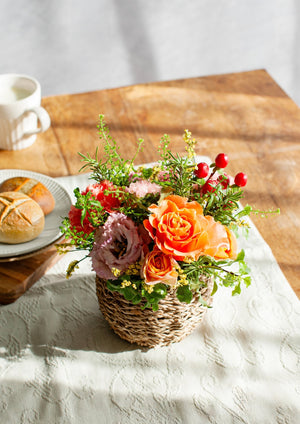
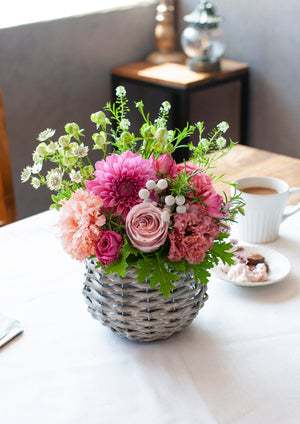
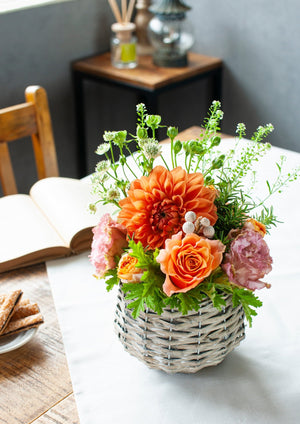
Hypericum is generally not displayed alone; it's often used as a floral material in bouquets and flower arrangements with other flowers.
While it rarely takes center stage, florists frequently use it because the addition of berries creates a high-quality finished product due to the difference in texture.
Hypericum is available year-round, so it's lovely to combine it with seasonal flowers. You can entrust your feelings of "sparkle" to Hypericum when gifting a bouquet or flower arrangement for birthdays or wedding anniversaries, or convey the sentiment of "sorrow does not last" when including it in a memorial flower arrangement.
Included in bouquets and flower arrangements

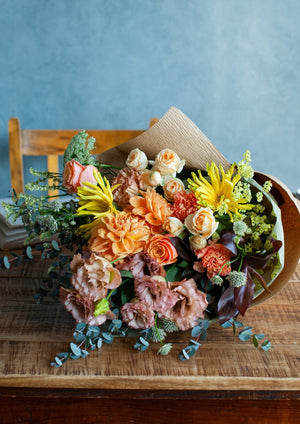
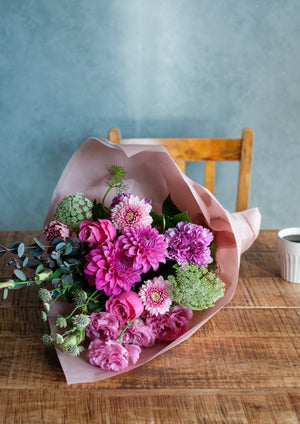
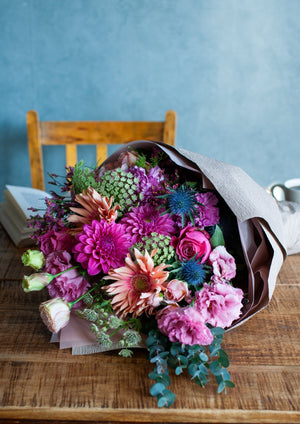
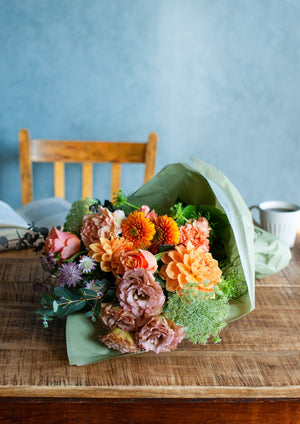
Adding Hypericum to popular flowers like roses and dahlias gives the entire floral gift a crisp, finished look.
This is because the glossy texture of Hypericum adds depth to the overall appearance through contrasting textures.
Hypericum is available year-round, making it lovely to combine with seasonal flowers. You can entrust the sentiment of "sparkle" when gifting a bouquet or flower arrangement for birthdays or wedding anniversaries, or convey the feeling of "sorrow does not last" by including it in memorial flower arrangements.
In autumn, "Autumnal Hypericum" is recommended!

In autumn, "Autumnal Hypericum" with leaves dyed yellow to red becomes available.
The autumnal Hypericum has beautifully colored leaves and is a popular branch that allows you to fully enjoy the autumn atmosphere.
Of course, it's lovely to incorporate it into flower arrangements and bouquets as an "autumn bouquet," but it's also recommended to simply display autumnal Hypericum alone in a vase. It will bring the autumn atmosphere into your room.

Seasonal Branches 50-60cm "Autumnal Hypericum" 5 Stems
¥6,600-
Summary

The flower language of Hypericum is "sparkle" and "sorrow does not last." Both are positive flower meanings and can be gifted for various occasions.
If you're giving it as a birthday or wedding anniversary gift, entrust your feelings to "sparkle." If it's a memorial arrangement, entrust your feelings to "sorrow does not last."
It's uncommon to give Hypericum alone as a gift, so please include it as a filler in flower arrangements or bouquets.
◆Correction History
December 10, 2025: Some years corrected. References and sources added.
Apr 18, 2025