What is Enkianthus campanulatus? Flower Language and its Meaning Explained!

What is Enkianthus campanulatus? Explaining its flower language and meaning!
Recently, more and more people are decorating their rooms with branches. There are various uses, from those who display large, dynamic branches to those who cut them into arm-sized pieces. With the spread of social media, rooms decorated with branches have become widely recognized, and it seems that more customers want to emulate this style.
A classic choice for branches to display in your room is Enkianthus campanulatus. It's characterized by being easy to care for and long-lasting.
In this article, we'll delve into Enkianthus campanulatus, explaining its flower language, history, and more. Please take a look!
Click here for special features on 365 days of birth flowers! ▶︎
Hugely popular in recent years!? What is Enkianthus campanulatus?

| Plant Name | Enkianthus campanulatus |
| Scientific Name |
Enkianthus perulatus |
| Family | Ericaceae |
| Genus | Enkianthus |
| Origin | Japan |
| Classification | Deciduous shrub |
Enkianthus campanulatus is a branch characterized by its finely branched appearance. It is very popular because branches last a long time.
Its leaves are a refreshing green, and their shape is appealing, quickly transforming the entire room into a cool, airy space when displayed. It also has a dynamic presence, making the room feel more expansive.
Additionally, in autumn, Enkianthus campanulatus with autumn foliage also becomes available, making it perfect for adding a seasonal touch.
Even if the leaves fall off, its delicate branches are still beautiful, making it an all-purpose branch that some people even display as bare branches.
When Enkianthus campanulatus is in season

Enkianthus campanulatus starts appearing around April, with its peak season being around June.
While its distribution decreases slightly in summer, autumn Enkianthus campanulatus is available from September to November, so if you want to bring an autumn atmosphere into your room, it's a good choice to display.
Unfortunately, it's important to note that it's not available in winter. It is essentially a spring to early summer flower material.
What is the origin of the name Enkianthus campanulatus?

The name Enkianthus campanulatus is said to come from the fact that its branched appearance resembles the legs of a knot-tying lantern. The name changed from "Toudai" (lantern) to "Doudan" (enkianthus).
In kanji, it is written as 灯台躑躅 (toudai-tsutsuji), preserving its origin. Incidentally, its alternative name is 満天星 (mantenboshi), which is also read as "Doudan-tsutsuji."
This is because the Chinese character notation was directly adopted, and the reading "Doudan-tsutsuji" was applied to it.
Is Enkianthus campanulatus poisonous!?

Knowledgeable people and elders often say that Enkianthus campanulatus is poisonous, but in fact, Enkianthus campanulatus is not poisonous.
Before the 1980s, plant encyclopedias listed Enkianthus campanulatus as poisonous, but there were actually no cases of poisoning from it.
It was left uninvestigated for a long time, and only recently was it chemically examined. It was then proven that Enkianthus campanulatus is non-toxic.
However, while Enkianthus campanulatus itself is safe, many species in the Rhododendron family are poisonous, so caution is still needed!
About the flower language of Enkianthus campanulatus

The flower meanings of Enkianthus campanulatus are "elegance," "temperance," "gratitude," "honest confession," and "receive my thoughts."
"Elegance" is said to derive from the modest white flowers of Enkianthus campanulatus.
"Temperance" comes from the plant's resilience to both heat and cold, and "receive my thoughts" is inspired by its autumn foliage.
Since it has many positive flower meanings, it is a flower material that you can safely give for celebrations.
Of course, it's also great for home interior decoration!
What month is Enkianthus campanulatus the birth flower?

Enkianthus campanulatus is the birth flower for March 28th and April 14th.
The birth flowers for March 28th are Japanese kerria, Calanthe, Enkianthus campanulatus, and boxwood. All evoke images of Japanese mountains and fields.
The birth flowers for April 14th are Enkianthus campanulatus, Scotch broom, Philadelphia fleabane, Blue Star, and Deutzia. All are plants with a refreshing impression.
What is the history of Enkianthus campanulatus?

Enkianthus campanulatus is a plant native to Japan, growing wild in Honshu (Kanto region and west), Shikoku, and Kyushu.
It first appeared in historical records during the Edo period. Its branched shape was said to resemble the legs of a 'Yui-tōdai' (a type of lantern) used in imperial courts, which is why it was called 'Tōdai-tsutsuji' (lantern azalea), and this name gradually changed to 'Dōdan-tsutsuji'.
Riding the gardening boom of the Edo period, its strong resistance to pruning made it highly popular as a hedge and garden tree, spreading to temples and gardens nationwide. The beauty of its white, urn-shaped flowers in spring and its fiery autumn foliage remains highly popular today. Many temples in Kyoto, for example, are known as famous spots for autumn foliage.
In recent years, its delicate beauty has been recognized, and it has gained popularity among gardeners in Europe and America, including the UK, as 'Japanese Enkianthus'.
(Reference: Keisen University Institute of Gardening and Cultural Horticulture "Horticultural Plants (Azalea)")
(Reference: Royal Horticultural Society (RHS) "AGM Plants - Ornamental")
Its big boom as a cut flower is quite recent!

It is only relatively recently that Enkianthus campanulatus has become widely popular as an interior decoration for ordinary homes, beyond its specialized uses in ikebana and other floral arrangements.
While it was originally primarily used as a garden tree or a material for ikebana, its value was rediscovered with the recent boom in natural interiors. Its delicate branching, refreshing green color, and cool appearance that blends into any room quickly gained popularity through social media.
Also, its 'exceptional longevity' is a major reason why professionals love it. It can be enjoyed for a long time even in summer, making it highly valued for displays in hotels and apparel shops, which seems to have led to an increase in people wanting to display it in their own homes.
As someone who has worked with flowers for a long time, I am surprised that Enkianthus campanulatus has become such a symbol of stylish interiors, but I am very happy that its beauty has been conveyed to so many people.
(Reference: Ota Kaki Co., Ltd. "FLOWER OF THE YEAR OTA 2019 (Grand Prize: Enkianthus campanulatus)")
What to do when Enkianthus campanulatus arrives?

When Enkianthus campanulatus arrives, first condition it for water. Conditioning for water means allowing the plant to absorb plenty of water.
First, cut the branch of Enkianthus campanulatus diagonally. Then, use scissors to make a split in the middle.
Finally, if you scrape off the bark of the branch that will be submerged in water with a knife or cutter, it will absorb water even better!
How to display Enkianthus campanulatus

It's good to display Enkianthus campanulatus in a place that doesn't get direct sunlight. As it's a plant with delicate leaves,
it might get scorched and shrivel up if exposed to too much sun. Also, be careful as strong winds might blow and cause the curtains to hit it, leading to the branch falling over.
Prepare a vase that is as deep as possible and arrange the branches to balance them, so the weight isn't concentrated on one side. After arranging, it's a good idea to check if it's stable and won't tip over.
Since it's a fairly large branch, please display it in a place like a counter where people don't often use it.
If you have a spacious dining table, it would also look lovely displayed in the center. Please enjoy a colorful life.
What to do if Enkianthus campanulatus leaves fall off?

Enkianthus campanulatus is a relatively long-lasting branch, but its leaves will fall off in about 1 to 2 weeks.
Once the leaves have fallen, the branch no longer needs water, so you can remove it from the vase.
Even as bare branches, they are very stylish, so please display them by leaning them against a wall or similar.
If you don't wish to display them, cut the branches into small pieces with pruning shears and dispose of them as combustible waste.
In doing so, be careful not to puncture the garbage bag.
If you want to give Enkianthus campanulatus as a gift?

If you want to give branches of Enkianthus campanulatus as a gift to someone special, what kind of gift should you choose?
Here, we will introduce Enkianthus campanulatus products. We will introduce items that are suitable for birthdays, wedding anniversaries, or seasonal greetings.
Of course, they are also great for decorating your own home. Please decorate your room with them and enjoy the stylish early summer atmosphere.
Simply give Enkianthus campanulatus branches

It's also recommended to simply give the branches. However, a vase is necessary for display, so don't forget to check if the recipient has one!
A vase with a wide opening is best. A cylindrical vase is perfect for Enkianthus campanulatus.
If you think they might not have a vase, it would be a good idea to present a vase along with the branches.
Give only Enkianthus campanulatus

Seasonal branches 60-70cm "3 Enkianthus campanulatus branches"
¥7,700-
Seasonal bouquet using Enkianthus campanulatus!

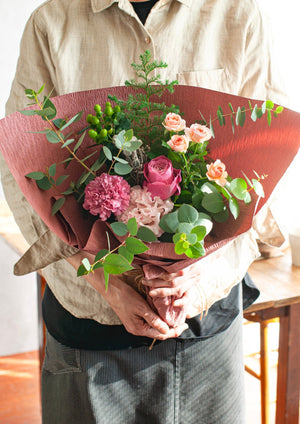
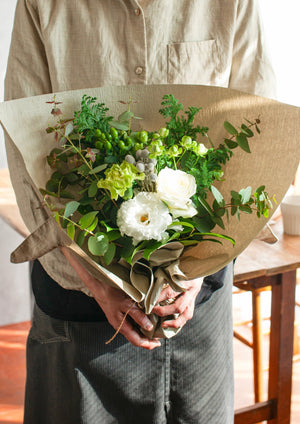
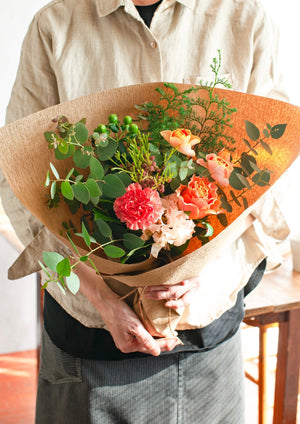
Enkianthus campanulatus is in season in early summer. It's a great idea to combine it with other seasonal flowers to create a lovely bouquet for a gift. It's especially recommended for birthday presents.
Adding branches to a bouquet gives it a dynamic feel and brings a spacious touch to a room.
Again, make sure to check if the recipient has a vase before giving it.
Bouquet using Enkianthus campanulatus

Seasonal Birthday Flower for August: "Enkianthus campanulatus and Lisianthus"
¥8,800-
Summary

The flower meanings of Enkianthus campanulatus are "elegance," "temperance," "gratitude," "honest confession," and "receive my thoughts." As they carry positive connotations, you can confidently give them as gifts.
When displaying them, make sure to prepare a vase with a wide opening. The trick is to arrange the branches to maintain balance so they don't tip over.
Why not try decorating your room with Enkianthus campanulatus to create an Instagrammable space? It's highly recommended as it will completely transform the atmosphere.
◆Revision History
December 11, 2025: Some years corrected. References and sources added.
Mar 12, 2025