What is the meaning of the Japanese bush clover flower? We also explain its history and some interesting facts!

What do the Japanese Bush Clover's flower meanings symbolize? Learn about its history and fun facts!
The Japanese Bush Clover (Hagi) is one of the Seven Autumn Herbs.
Its slender branches gracefully bend and sway in the wind, a sight that has captivated the hearts of Japanese people since ancient times.
Hagi is a very elegant flower. It's a favorite among both flower enthusiasts and those less familiar with flowers. Do you know what flower meanings and history this Hagi possesses?
In this article, we will thoroughly explain everything about Hagi, from its flower meanings to the origin of its name, its history, and even some surprising fun facts.
Why not delve into the profound world of Hagi and be captivated by its charm?
Basic Information about Japanese Bush Clover (Hagi) Flowers

First, let's look at some basic information about what Hagi is.
What are the characteristics of Hagi flowers?
| Plant Name | Hagi (Japanese Bush Clover) |
| Scientific Name |
Lespedeza |
| Family | Fabaceae (Legume family) |
| Genus | Lespedeza |
| Origin | East Asia |
| Blooming Season | July to September |
Hagi is a deciduous shrub in the pea family.
It has slender branches with many small, butterfly-shaped flowers. The colors are typically crimson or purple.
Its gracefully drooping branches create an elegant and beautiful impression.
It is especially picturesque among the Seven Autumn Herbs and has been loved by many people.
Being in the same legume family, its appearance is somewhat similar to a sweet pea.
What is the origin of the Hagi flower's name?
There is a theory that the name Hagi comes from "Haeki" (生え芽), meaning "sprouting buds," due to its strong vitality in producing new shoots every year, which then transformed into "Hagi."
Also, as indicated by the kanji character 「萩」 (hagi), which combines "grass" (草) and "autumn" (秋), it signifies a representative grass of autumn.
It's interesting to learn about the origin through the kanji.
When do Hagi flowers bloom?
Hagi blooms from around July to October.
Although it is counted among the Seven Autumn Herbs, giving it a strong image as an autumn flower, it actually begins to bloom in summer and can be enjoyed for a long period.
Where do Hagi flowers grow?
Hagi grows widely in sunny areas such as mountains, hills, and riverbanks throughout Japan.
Its beautiful appearance blooming in nature has long soothed the hearts of Japanese people.
What is the English name for Hagi flowers? And what is its origin?
The English name for Hagi is "Bush Clover." "Bush" means "shrub" and "Clover" refers to "leguminous plants," describing Hagi's characteristics.
It is also sometimes called "Japanese Clover."
About the flower meanings of Hagi

The flower meanings of Hagi are often derived from its elegant appearance and modest blooming style.
1. "Contemplation"
The branches swaying in the wind resemble someone deep in thought.
The downward-facing blossoms also evoke this flower meaning, creating an atmosphere of reserved elegance.
This melancholic appearance perfectly suits the autumn season.
2. "Shyness"
The modest way the flowers bloom and their gently drooping appearance are associated with the image of a shy and reserved woman.
The flower meaning "shyness" expresses Hagi's understated beauty.
3. "Gentle heart"
The slender branches gracefully bend and gently sway with every gust of wind, expressing a flexible and calm heart.
This flower meaning perfectly suits Hagi's gentle atmosphere.
What is the history of Hagi flowers?

Hagi is an indispensable part of Japanese history and culture.
Appears in the oldest poetry collection, "Manyoshu"
The history of Hagi dates back to the Manyoshu, Japan's oldest poetry collection.
Hagi appears first in the poem of the "Seven Autumn Herbs" composed by Yamanoe Okura.
It is also the most frequently sung flower in the Manyoshu, with over 140 poems dedicated to it.
Hagi blooming in the autumn fields captivated the hearts of people at that time, and it was cherished as a flower to express the bittersweetness of love, the loneliness of parting, and fleeting emotions.
(Reference: Asahi-net "Hagi no Hana Waka Saijiki")
Click here for more on the Seven Autumn Herbs ▶︎
Also appears in The Pillow Book!
In the Heian period, Hagi played an even more important role in aristocratic culture.
"The Pillow Book"
Sei Shonagon's "The Pillow Book" contains the line, "The wind blowing so fiercely it turns the Hagi leaves inside out," depicting a stormy garden after a typhoon.
(Reference: Frontier Koten Kyoshitsu "Pillow Book 'The Day After the Storm' Modern Japanese Translation")
Hagi flowers used in family crests
Due to its design, Hagi was sometimes used as a family crest (mon).
For example, there are several variations such as "Kyu-mai Hagi Mon" (nine-leaved bush clover crest), "Dakihagi" (embracing bush clover), "Tsunebagi" (bundled bush clover), and "Maru ni Kyu-mai Hagi" (nine-leaved bush clover in a circle).
The origin and meaning of the "Hagi Mon" were said to be "regeneration," "prosperity of descendants," and "an auspicious plant." Hagi has been loved by Japanese people as a very auspicious plant.
(Reference: Kamon no Iroha "About the Hagi Mon")
Hagi remains in surnames and place names
Hagi is often found in Japanese surnames and place names. Hagi City in Yamaguchi Prefecture was named after it was once a beautiful place where Hagi grew wild.
Surnames like Hagiwara and Hagino often originate from places where Hagi bloomed.
(Reference: Hagi City "Overview of Hagi City")
Overseas, it was also historically used for soil conservation.
Overseas, Hagi has been used for purposes slightly different from those in Japan.
There is a history of a type of Hagi, Lespedeza, being introduced in places like America for pasture and to enrich the soil of barren land.
However, in some regions, its vigorous growth has led it to outcompete native species, so it is now considered an invasive alien species, and efforts to eradicate it are underway in some areas.
(Reference: US Forest Service "Lespedeza bicolor")
(Reference: IUCN "Global Invasive Species Database: Lespedeza cuneata")
Fun Facts About Hagi Flowers

Hagi, a flower loved by Japanese people since ancient times, holds many interesting anecdotes and surprising aspects.
Knowing them will surely make you love Hagi even more.
By far the most frequently appearing plant in the Manyoshu!
Among the Seven Autumn Herbs sung by Yamanoe Okura, Hagi held a special place.
It is overwhelmingly the most frequently mentioned plant in the Manyoshu, Japan's oldest poetry collection.
Its number exceeds 140 poems!
This shows that for aristocrats and commoners of the time, Hagi blooming in the autumn fields was an indispensable flower for expressing the bittersweetness of love and fleeting emotions.
Hagi flowers were also used in family crests.
Despite its elegant appearance, Hagi possesses a strong vitality, growing robustly even in harsh environments.
This characteristic resonated with the samurai's integrity and perseverance, leading to its frequent use in family crests.
It is well-known that the warlord Kobayakawa Takakage used a Hagi family crest.
It feels even more charming to think that a seemingly delicate flower symbolized the soul of a samurai.
Even today, many homes might still have Hagi flowers in their family crests. If you're not sure, you might check the crests depicted on old family belongings or storehouses.
It's actually a legume!
Hagi is a leguminous plant.
Therefore, after its lovely butterfly-shaped flowers fade in autumn, it produces small, bean-like pods.
While its beautiful flowers usually draw attention, try observing the pods as well.
You might discover a surprising side of this plant, typical of legumes.
Moon viewing and Hagi
Since ancient times, Japanese people have cherished the custom of admiring the moon.
At such times, Hagi, along with pampas grass (susuki), was an indispensable presence.
As the saying goes, "Clouds for the moon, wind for the flowers," adding Hagi to moon viewing heightened the charm of an autumn evening.
The moon and Hagi are an inseparable combination in Japan's traditional aesthetic sense.
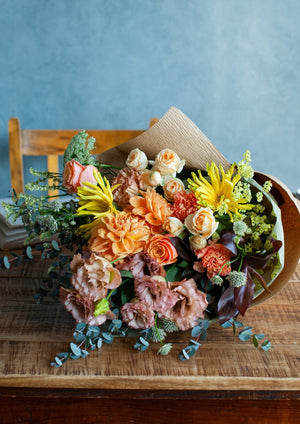
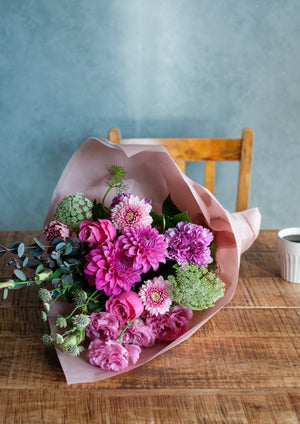
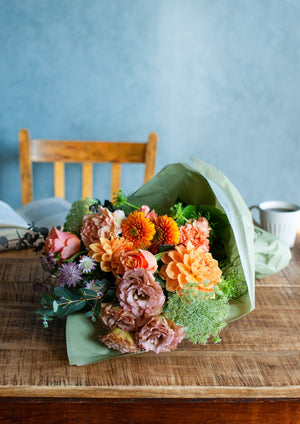
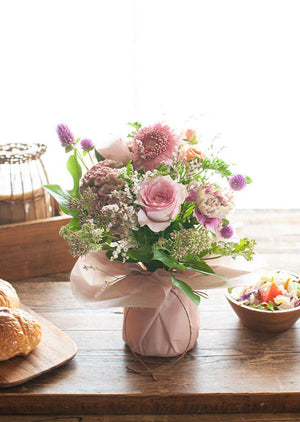
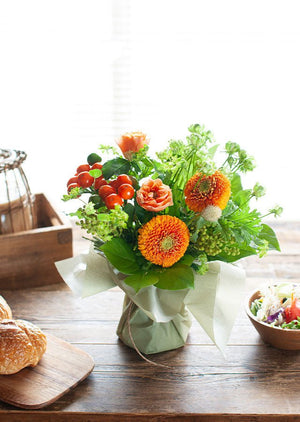
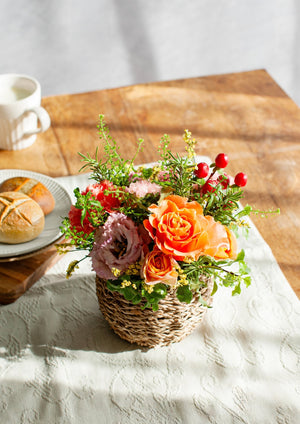
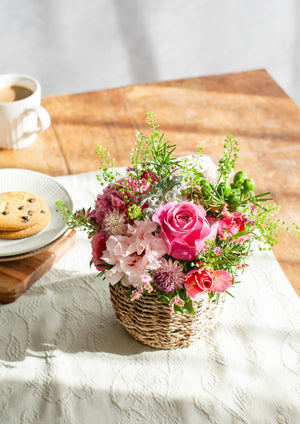
&YOUKAEN is currently selling flower arrangements using autumn flowers!

&YOUKAEN is currently selling seasonal autumn flower arrangements.
Using seasonal flowers only available at this time of year, our arrangements are stylishly crafted to be suitable for both women and men.
We create high-quality floral gifts using only fresh flowers in excellent condition, which our florists proudly present.
Recommended for birthdays, wedding anniversaries, or as home decor. Please consider gifting them to someone special.
Flowers are the only gift that can "present a season." Please enjoy autumn.
Stylish flower arrangements using autumn flowers

Limited Time Japanese-Style Flower Arrangement M "irodori"
¥8,250-
Summary

Hagi is a graceful flower with meanings such as "contemplation" and "shyness."
As one of the Seven Autumn Herbs and the most frequently appearing flower in the Manyoshu, it has been cherished by Japanese people since ancient times.
By decorating with Hagi, you can feel Japan's rich history and culture.
&YOUKAEN offers stylish bouquets and flower arrangements made with flowers only available in autumn.
Each one is carefully crafted by our florists, making them perfect gifts for your loved ones.
For birthdays and wedding anniversaries, send a flower gift from &YOUKAEN.
◆Revision History
December 9, 2025: Some years corrected. References and sources added.
Aug 13, 2025