The Bellflower: A Detailed Look at its Flower Meaning and History!

Kikyō (Bellflower): A Detailed Look at its Flower Meanings and History!
The Kikyō (Bellflower) is known as one of the seven autumnal flowers.
Its star-like, beautiful flower shape and elegant purple or white hues are captivating.
Do you know about the flower meanings and history of this charming autumn flower, the Kikyō?
This article will provide a thorough explanation of everything about the Kikyō, from its flower meanings to the origin of its name, its history, and its cultural background.
Why not delve into the profound world of the Kikyō and be captivated by its charm?
Click here for our featured seasonal branches and flowers! ▶︎
Kikyō (Bellflower) Basic Information

First, let's look at some basic information about the Kikyō flower.
What kind of flower is the Kikyō (Bellflower)?
| Plant Name | Kikyō (Bellflower) |
| Scientific Name |
Platycodon grandiflorus |
| Family | Campanulaceae |
| Genus | Platycodon |
| Origin | Japan, Korean Peninsula, China |
| Blooming Season | Around June to October |
The Kikyō is a perennial plant belonging to the Campanulaceae family. Its most distinctive feature is its beautiful star-like, five-pointed flower shape.
Since its buds swell up like balloons, it has been given the unique English name "Balloon Flower".
While purple, commonly found in fields and mountains, is typical, there are also various other colors such as white and pink.
What is the origin of the Kikyō (Bellflower) name?
There are several theories regarding the origin of the Kikyō's name.
Chinese Name "Jiegeng" Read Aloud
The most widely accepted theory is that the Chinese name "Jiegeng" (桔梗) changed to "Kikyō" as it was introduced to Japan.
From "Kikkyō" (Good or Bad Fortune)
Another theory suggests that in ancient times, the Kikyō was used as a flower to tell "Kikkyō" (good or bad fortune).
It is said that the custom of throwing flowers to predict good or bad fortune led to the name "Kikkyō" transforming into "Kikyō".
From the Korean "Doraji"
The root of the Kikyō has long been used as a traditional Chinese medicine, and in the Korean Peninsula, the root was called "Doraji".
This theory suggests that when "Doraji" was introduced to Japan, it was pronounced "Kichi," which then transformed into "Kikyō."
"Okatotoki"
In ancient times, it was also called "Okatotoki" (岡止々支), meaning "sacred herb blooming on the hill." This theory suggests it derived from "Totoki," the old name for the harebell (Tsuriganeninji).
From these theories, it's clear that the Kikyō's name originated from words introduced from China and the Korean Peninsula, and was also linked to ancient Japanese culture.
What is the English name for Kikyō (Bellflower)?
The English name for Kikyō comes from its unique shape.
Because its buds swell up like balloons, it's called "Balloon Flower," and because its open flowers resemble the shape of a bell, it's also called "Bellflower."
About Kikyō (Bellflower) Flower Meanings

The flower meanings of the Kikyō often derive not only from its delicate appearance but also from its profound history and culture.
What are the flower meanings of Kikyō (Bellflower)?
・"Eternal Love": This flower meaning originated from its depiction as a symbol of love in the Manyōshū and the Kikyō's long blooming period.
・"Sincerity": Although not a showy flower, its delicate and pure appearance evokes a sense of sincerity.
・"Elegance": A flower meaning with a noble image, befitting the flower's graceful appearance.
・"Unchanging Love": This flower meaning perfectly matches the Kikyō's profound atmosphere and is ideal for conveying unwavering feelings as a gift.
Do Kikyō (Bellflower) flower meanings vary by color?
・Purple Kikyō: Carries flower meanings befitting a noble image, such as "elegance" and "grace."
・White Kikyō: Has flower meanings befitting a clean and pure image, such as "purity" and "sincerity."
Slightly Ominous Flower Meanings of Kikyō (Bellflower)
The Kikyō also has some slightly ominous flower meanings.
・"Jealousy": One theory suggests that in the Heian period, the Kikyō's beauty, surpassing other flowers, brought to mind jealousy.
・"Revenge": Another theory links this to the Honnō-ji Incident, as Akechi Mitsuhide, a samurai general of the Sengoku period, had the Kikyō crest as his family emblem.
These flower meanings are generally not well-known, and typically, positive flower meanings are dominant.
When giving them as a gift, it's best to include a positive flower meaning.
What is the history of Kikyō (Bellflower)?

The Kikyō is not just a beautiful flower.
It is deeply intertwined with Japanese history and culture, weaving various stories.
1. Appears in "Manyōshū," Japan's Oldest Anthology of Poetry
The history of the Kikyō dates back to the Nara period.
It appears as one of the "seven autumnal flowers" in a poem by Yamanoe Okura in Japan's oldest poetry anthology, the "Manyōshū."
At that time, it was called "Asagao no Hana" (morning glory flower). It is likely that its star-like flower shape and its blooming in the morning were cherished by people back then. (*There is also a theory that Asagao no Hana refers to the Mukuge (Rose of Sharon)).
(Reference: Asahi-net "Kikyō (ききやう/きちかう)")
2. History of Being Valued as a Family Crest by Samurai Families during the Sengoku Period
Due to its well-balanced and beautiful pentagonal shape, the Kikyō flower was widely used as a family crest by samurai families during the Sengoku period.
It is famous as the family crest of the Toki clan of Mino and their descendant Akechi Mitsuhide. The reasons why it was favored by samurai were its pure and upright image and its beautifully organized shape.
However, after the "Honnō-ji Incident", where Akechi Mitsuhide attacked Oda Nobunaga, the Kikyō crest temporarily acquired a dishonorable image as a symbol of "betrayal."
It is said that Katsunari Mizuno, for example, changed his crest to a Gegyomon (懸魚紋, a decorative roof ornament crest).
(Reference: Wikipedia "Kikyōmon")
3. History of Use from Folk Medicine to Traditional Chinese Medicine
The Kikyō has been used not only as a beautiful flower but also as a medicine since ancient times.
The root of the Kikyō is dried to become the herbal medicine "Kikyōkon" (桔梗根).
This herbal medicine is said to have effects that suppress coughs and relieve sore throats, and it is still compounded in traditional Chinese medicines such as "Kikyōtō" (桔梗湯).
In Japan, the Kikyō has naturally grown in fields and mountains since ancient times, so there is a history of its widespread use as a folk remedy.
(Reference: Kagoshima Pharmaceutical Association "Kikyō")
The Kikyō is a flower that has thus been a part of Japanese life in various ways throughout the ages.
Knowing not only its beauty but also its powerful history will undoubtedly deepen your feelings for the Kikyō.
Kikyō (Bellflower) and Culture

The Kikyō has been deeply involved with various cultures throughout its long history.
1. One of the Seven Autumnal Flowers
The Kikyō, along with susuki (pampas grass) and hagi (bush clover), has been cherished since ancient times as one of the "seven autumnal flowers."
While the seven spring flowers are for "eating," the seven autumnal flowers are for "admiration," representing the seasonal charm of autumn fields and mountains.
They were also used as decorations for Tsukimi (moon viewing) on the Mid-Autumn Festival, teaching the Japanese people about the changing seasons in their daily lives.
2. The "Pentagram" as a Symbol of Onmyodo and Amulets
The Kikyō flower has five petals and a pentagonal star shape.
This pentagram has long been regarded as a symbol of protection against evil.
In particular, since Onmyoji (geomancer) Abe no Seimei used the pentagram as his family crest during the Heian period, the Kikyō also came to be believed to possess magical and mystical powers.
Therefore, the Kikyō has been cherished as a "guardian flower" for the home, warding off evil and wishing for family safety.
3. Authority and Sorrow as a Samurai Family Crest
The history of its heavy use as a samurai family crest during the Sengoku period is also an indispensable element when discussing the Kikyō from a cultural perspective.
By being used in family crests, the Kikyō became not just a flower, but a symbol of a family's pride and authority.
However, its tragic association with Akechi Mitsuhide gave it a complex meaning, encompassing both glory and sorrow.
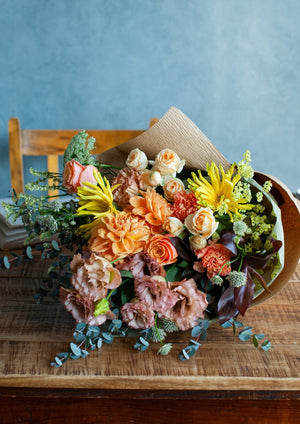
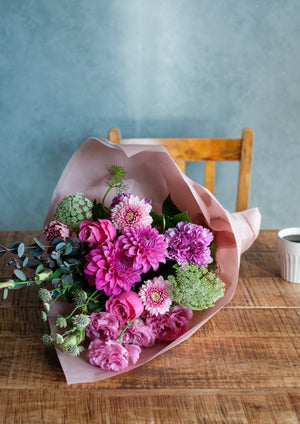
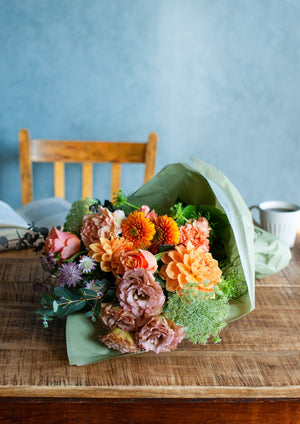
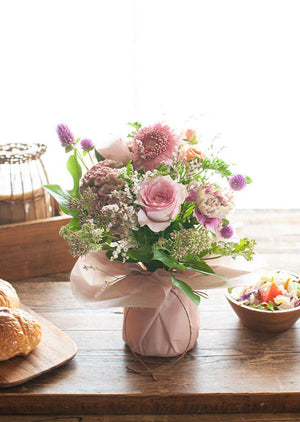
&YOUKAEN is Selling Bouquets Featuring Kikyō (Bellflower)!

&YOUKAEN offers bouquets that highlight the elegant beauty and profound atmosphere of the Kikyō.
Our sophisticated designs, combining Kikyō with seasonal flowers, are perfect for gifts to loved ones.
Our florists carefully select high-quality Kikyō and craft each arrangement with care.
Recommended for birthdays, wedding anniversaries, or as a present to express daily gratitude. Please consider them.
Limited-Time Bouquets Featuring Kikyō

Seasonal Bouquet "Wistaria -Azure of the Fading Summer-"
¥12,650-
Summary

The Kikyō is a beautiful flower with meanings such as "eternal love" and "sincerity."
Its history is ancient, having been loved by people from the Manyōshū era to the present day.
The mystical power of its star-shaped flowers gives us a quiet sense of awe.
At &YOUKAEN, we offer beautiful bouquets so that everyone can fully enjoy the charm of the Kikyō.
Why not choose a Kikyō for a gift to a loved one or as an interior decoration for your home?
Our expert florists will wholeheartedly assist you in choosing your flowers.
Click here for our featured seasonal branches and flowers! ▶︎
◆Revision History
December 10, 2025: Corrected some years. Added reference and source information.
Aug 11, 2025