Autumn Seven Herbs: A Complete Guide! Introducing Types and Names

A Comprehensive Guide to the Seven Autumn Flowers! Types and Names Explained
When it comes to the seven spring flowers, many may think of nanakusa-gayu (seven-herb rice porridge). But do you know what flowers are included in the seven autumn flowers?
In this article, we will thoroughly explain the types and names of the seven autumn flowers one by one, along with their history and how to enjoy them.
By learning about the seven autumn flowers, why not spend a richer and more atmospheric autumn?
What are the Seven Autumn Flowers?

First, let's explain the basics of what the seven autumn flowers are.
What are the Seven Autumn Flowers?
The seven autumn flowers refer to a general term for seven representative types of grasses and flowers that bloom in the fields and mountains during autumn.
While the seven spring flowers are used for "eating" in nanakusa-gayu, the seven autumn flowers are for "appreciation," enjoyed for their beauty, which is a key difference.
What is the history of the Seven Autumn Flowers?
The seven autumn flowers originate from a poem found in the "Man'yoshu," compiled during the Nara period.
The seven plants mentioned in the poem by Yamanoue Okura later became established as the "seven autumn flowers."
During the Heian period, it is said that "Nanakusa-gari" (seven-herb hunting), where nobles strolled through fields and mountains to admire the seven autumn flowers, became popular.
What is the difference between the Seven Autumn Flowers and the Seven Spring Flowers?
The biggest difference between the seven autumn flowers and the seven spring flowers is how they are enjoyed.
・Seven Spring Flowers: Seri (water dropwort), Nazuna (shepherd's purse), Gogyo (cudweed), Hakobera (chickweed), Hotokenoza (henbit), Suzuna (turnip), Suzushiro (daikon radish). These are "eaten" in nanakusa-gayu to pray for good health.
・Seven Autumn Flowers: Hagi (bush clover), Susuki (Japanese pampas grass), Kuzu (kudzu), Nadeshiko (fringed pink), Ominaeshi (patrinia), Fujibakama (thoroughwort), Kikyo (bellflower). These are enjoyed by "appreciating" their delicate appearance.
Both are important cultural traditions that mark the changing seasons, but their ways of enjoyment are entirely different.
Explaining the Types of Seven Autumn Flowers!
Each of the seven autumn flowers has its own unique charm. Let's look at the characteristics and flower meanings of each one.
Hagi (Bush Clover)

| Plant Name | Hagi (Bush Clover) |
| Scientific Name |
Lespedeza |
| Family | Fabaceae (Legume family) |
| Genus | Lespedeza |
| Origin | East Asia |
| Flowering Season | July to September |
The first of the seven autumn flowers is Hagi. It blooms with many small reddish-purple flowers on slender stems, beautifully coloring the autumn fields and mountains.
Its flower meanings include "deliberation" and "shyness," giving it a modest and refined atmosphere.
Click here for more about Hagi ▶︎
Obana (Japanese Pampas Grass)

| Plant Name | Susuki (Japanese Pampas Grass / Obana) |
| Scientific Name |
Miscanthus sinensis |
| Family | Poaceae (Grass family) |
| Genus | Miscanthus |
| Origin | East Asia |
| Flowering Season | Around August to October |
Obana refers to Susuki, or Japanese pampas grass. Its swaying appearance in the wind is a well-known autumn sight.
Its flower meanings include "vitality" and "understanding," conveying a strong sense of life force.
It is also an essential plant for moon-viewing decorations.
Click here for more about Susuki ▶︎
Kuzu (Kudzu)

| Plant Name | Kuzu (Kudzu) |
| Scientific Name |
Pueraria lobata |
| Family | Fabaceae (Legume family) |
| Genus | Pueraria |
| Origin | Japan, China, Korean Peninsula |
| Flowering Season | July to September |
Kuzu is a climbing plant that blooms with reddish-purple flowers in autumn. The fragrance of its flowers is also captivating.
It is also known for its roots being used to make kudzu starch and kudzu root medicine.
Its flower meaning is "sigh of love," perfectly suiting the atmospheric autumn scenery.
Click here for more about Kuzu ▶︎
Nadeshiko (Fringed Pink)

| Plant Name | Nadeshiko (Fringed Pink) |
| Scientific Name |
Dianthus |
| Family | Caryophyllaceae (Pink family) |
| Genus | Dianthus |
| Origin | Europe, North America, Asia |
| Flowering Season | June to September |
Nadeshiko blooms with delicate and lovely pink flowers. The term "Yamato Nadeshiko" (the idealized Japanese woman) is famously derived from its appearance.
Its flower meanings include "pure love" and "fidelity," representing feminine beauty and purity.
Click here for more about Nadeshiko ▶︎
Ominaeshi (Patrinia)

| Plant Name | Ominaeshi (Patrinia) |
| Scientific Name |
Patrinia scabiosifolia |
| Family | Caprifoliaceae (Honeysuckle family) |
| Genus | Patrinia |
| Origin | Japan, Korean Peninsula, China |
| Flowering Season | Around July to September |
Ominaeshi is characterized by clusters of small yellow flowers. It has long been compared to the beauty of women. Its flower meanings include "beauty" and "fleeting love."
Click here for more about Ominaeshi ▶︎
Fujibakama (Thoroughwort)

| Plant Name | Fujibakama (Thoroughwort) |
| Scientific Name |
Eupatorium japonicum |
| Family | Asteraceae (Daisy family) |
| Genus | Eupatorium |
| Origin | China |
| Flowering Season | Around mid-August to mid-October |
Fujibakama blooms with pale purple flowers and has a unique, pleasant fragrance. Due to its scent, it was historically used as a perfume.
It is also known for attracting butterflies seeking nectar. Its flower meaning is "gentle memories."
Click here for more about Fujibakama ▶︎
Kikyo (Bellflower)

| Plant Name | Kikyo (Bellflower) |
| Scientific Name |
Platycodon grandiflorus |
| Family | Campanulaceae (Bellflower family) |
| Genus | Platycodon |
| Origin | Japan, Korean Peninsula, China |
| Flowering Season | Around June to October |
Kikyo blooms with beautiful star-shaped purple flowers. It has been cherished since ancient times, even appearing in the "Man'yoshu" anthology.
Its flower meanings include "eternal love" and "sincerity," carrying romantic connotations.
How to Enjoy the Seven Autumn Flowers

Unlike the seven spring flowers, the seven autumn flowers are admired for their beauty rather than consumed.
There are various ways people have cherished them since ancient times in Japan.
1. Display them in a single-flower vase or as a bouquet
The simplest and most beautiful way to enjoy the seven autumn flowers is to arrange them in a vase.
Even a single stem of delicate Hagi or a star-shaped Kikyo in a vase can bring an autumn ambiance to a room.
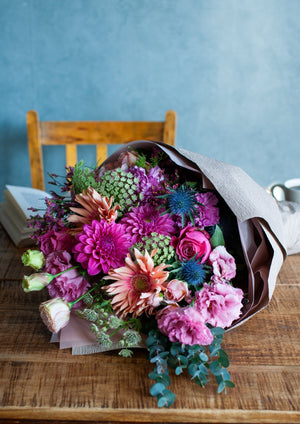
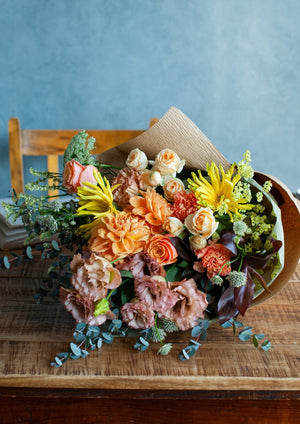
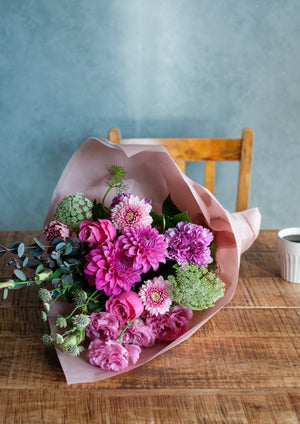
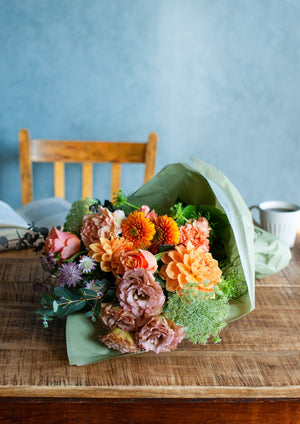
If you gather all seven flowers into a bouquet, it becomes a magnificent decoration, as if a slice of the autumn field were brought indoors.
For moon-viewing season, a bouquet with Susuki as the main element is highly recommended.
2. Enjoy the seasonal charm as a moon-viewing decoration
Moon-viewing, an autumn tradition, is famously associated with displaying Susuki. However, decorating with other seven autumn flowers together will enhance the seasonal charm even more.
Why not spend a luxurious time enjoying moon-viewing dumplings while gazing at the full moon and beautiful autumn flowers?
3. Make pressed flowers or dried flowers
Many people might wish to enjoy the seven autumn flowers they've acquired for a longer time.
The seven autumn flowers are also suitable for making pressed flowers or dried flowers.
Especially Susuki and Fujibakama, which tend to retain their beauty when dried, can easily be made into dried flowers.
This allows you to enjoy them twice: once for their fresh beauty and again for the nostalgic atmosphere of dried flowers.
4. Engage with literature as themes for Waka and Haiku poems
The seven autumn flowers have long been cherished as themes for Waka and Haiku poetry.
Contemplating the poems written by people of the past while gazing at the seven autumn flowers, or even trying to compose your own Haiku, is a refined way to enjoy them.
Through these flowers, you can connect with Japan's rich literary culture.
The seven autumn flowers offer us modern individuals hints for feeling the seasons and enriching our lives.
Please try enjoying the seven autumn flowers in various ways.
Are the Seven Autumn Flowers Edible?

The seven autumn flowers and the seven spring flowers differ significantly in how they are enjoyed.
While the seven spring flowers are eaten in nanakusa-gayu to pray for good health, the seven autumn flowers are not for consumption.
Seven Spring Flowers are "Edible," Seven Autumn Flowers are for "Appreciation"
The seven autumn flowers consist of Hagi (bush clover), Susuki (Japanese pampas grass), Kuzu (kudzu), Nadeshiko (fringed pink), Ominaeshi (patrinia), Fujibakama (thoroughwort), and Kikyo (bellflower)—a total of 7 types.
These plants are meant to be enjoyed for their beauty and are not suitable for consumption.
While some, like Kuzu, have roots used for kudzu starch or kudzu root medicine, their flowers and stems are not eaten.
Do they include poisonous plants?!
Some of the seven autumn flowers are poisonous.
For example, while Kikyo roots can be used as herbal medicine, taking them casually without expert knowledge can lead to poisoning.
Furthermore, the edibility of other plants has not been confirmed. There is a risk of becoming ill if ingested by mistake, so please do not consume them under any circumstances.
Do not confuse them with the seven spring flowers.
Since they both share the name "seven herbs/flowers," some might confuse them with the seven spring flowers. However, they are entirely different plants.
The seven spring flowers are non-toxic and edible, whereas the seven autumn flowers are intended for appreciation.
Please understand this distinction clearly and safely enjoy the charm of autumn.
&YOUKAEN is Selling Susuki!

&YOUKAEN offers Susuki perfect for moon-viewing decorations.
Susuki, which brings a strong sense of the season among the seven autumn flowers, is carefully selected and sold with a focus on quality.
It can be easily purchased, so please take advantage of it.
Recommended Susuki Products

Autumn "Susuki" 10-stem bouquet, 70cm tall
¥5,500-
Summary

Unlike the seven spring flowers, the seven autumn flowers are meant to be admired.
Hagi, Susuki, Kuzu, Nadeshiko, Ominaeshi, Fujibakama, Kikyo.
By knowing the beauty of each flower, you will be able to feel the charm of autumn more deeply.
&YOUKAEN offers a wide variety of seasonal plants.
We are here to help you adorn your autumn life with moon-viewing decorations and autumn bouquets.
Our specialized florists will wholeheartedly assist you in choosing your flowers.
Aug 06, 2025