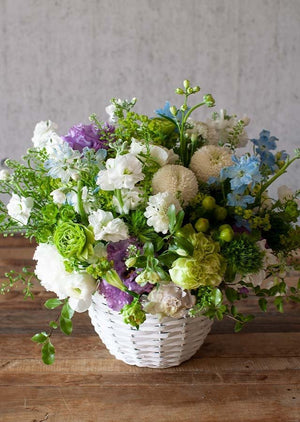
Obon Arrangement Made with Long-Lasting Flowers


As the Obon season approaches, many people may be wondering, "What should I place on the Buddhist altar when I return to my hometown?" or "It's my first Obon, are there any manners for offering flowers?"
Decorating with flowers for Obon is a heartfelt act of remembrance, expressing gratitude to the deceased and respect to ancestors. This article will thoroughly explain how to choose appropriate flowers for Obon, essential etiquette to know, and recommended flower types.
One read will make you an expert in Obon flower selection! You're sure to find the perfect flowers to convey your feelings to the deceased!
Please read to the end.

There are several etiquette rules for Obon offering flowers to show consideration for the deceased and their family.
Knowing these will help you make a more heartfelt offering!

The color of offering flowers is generally chosen based on the Obon season and your relationship with the deceased.
For the first Obon (Hatsu Bon / Shin Bon) since a person's passing, it is customary to choose white-based flowers.
White chrysanthemums, white lilies, and white lisianthus are common and readily available choices.
Choosing white flowers symbolizes mourning and purity, and shows consideration for the bereaved family.
To express deep respect for the deceased, it is best to use pure white, or white with a touch of pale green.
For the second Obon and subsequent ones, while white remains the base, you may add colors that the deceased loved or slightly brighter pale colors (light purple, pale pink, light blue, pale yellow, etc.).
Choosing colors that match the image of the deceased allows for a more personal expression of remembrance.
However, avoid primary colors or overly flamboyant hues, and always aim for subdued tones.
Attaching a message card conveying your thoughts to the deceased is also recommended.

There are also flowers that are considered best to avoid as offerings. These are also based on manners to show consideration for the deceased and their family.
While many people don't mind these days, it's a good idea to be careful if you're sending flowers to a superior.
Flowers with thorns, such as roses, are generally avoided in Buddhist ceremonies as they are associated with "conflict" or "harsh feelings."
Furthermore, there's a risk of injury when arranging them, so it's safer to refrain from using them.
Flowers with strong scents, such as certain varieties of lilies and freesias, should sometimes be avoided out of consideration for bereaved family members who may be unwell or have allergies.
If you are unaware of the deceased's or family's circumstances, it is safest to choose flowers with little fragrance.
Poisonous flowers such as cluster amaryllis, lily of the valley, and narcissus are not suitable for offerings, especially in households with children or pets, as they pose a particular danger.
Choose with safety in mind.
Vining plants like morning glories and climbing roses are considered unsuitable for Buddhist flower offerings due to their association with "thoughts entwining around the deceased" or "being unable to return from the afterlife."
Potted plants are associated with the word "ne-tsuku" (to take root), which can sound like "ne-tsuku" (to fall ill or be bedridden).
While they are considered auspicious for celebratory occasions, implying prolonged illness, they are generally avoided for Buddhist ceremonies.
However, in recent years, potted Western orchids such as phalaenopsis have become popular, and pure white ones that are not too showy are highly recommended.

Ideally, offering flowers should remain beautiful throughout the Obon period. Therefore, it is important to choose flowers that last a long time.
Especially during Obon in the summer, temperatures are high and flowers tend to wilt quickly, so choose fresh, long-lasting varieties.
![[By Scene] Recommended Flowers for Obon](https://cdn.shopify.com/s/files/1/0694/5472/5400/files/column_obon_03.jpg?v=1750726540)
From here, we will introduce particularly recommended types of flowers for Obon offerings, along with their respective characteristics.
Please choose the best flowers to convey your feelings to the deceased.

The representative flower for offerings is undoubtedly the chrysanthemum.
Traditionally believed to ward off evil, it has become a staple offering flower in Japan. It is characterized by its excellent longevity and diverse varieties.
With a single bloom, they command presence and convey a sense of formality.
These have small flowers clustered together, giving a cute impression and are suitable for filling gaps in arrangements.
These are varieties with multiple flowers blooming from a single stem, often used in modern arrangements.
While white and yellow chrysanthemums are classic, florists also offer chrysanthemums in various shades such as pale pink and green these days, so you can choose according to the deceased's preferences.
The flower language of chrysanthemums includes "nobility," "purity," and "longevity." These are positive and lovely meanings, so they are highly recommended.


Lilies, with their clear and elegant appearance, are also very popular as Obon offering flowers.
Especially white Casablanca and Teppō-yuri lilies convey feelings of remembrance with their stately beauty.
Pure white lilies have a clean image and are perfect for the first Obon.
However, some varieties have strong scents, so considering the family's situation, it's best to choose a less fragrant variety or confirm beforehand.


Lisianthus, with its beautiful ruffled petals and elegant appearance.
It has become particularly popular for offering flowers recently.
It comes in a rich variety of calming colors suitable for Obon, such as white, purple, and pale pink, and is known for its good longevity.
Its elegant look complements any arrangement. If you're unsure, definitely consider giving an arrangement with Lisianthus.

 Although carnations are strongly associated with Mother's Day, they are also suitable as offering flowers if you choose white, pale pink, or pale purple colors.
They last a long time and have a relatively simple appearance, making them easy to combine with other flowers.
Choosing carnations in colors that the deceased loved is also a heartfelt way to mourn.
 Gentian, one of the seven autumnal flowers, comes into season during Obon, making it highly recommended for adding a seasonal touch.
Its calm blue and purple hues are perfect for a quiet and solemn atmosphere.
With a flower meaning "I love you in your sorrow," it is a fitting flower to convey deep affection for the deceased.
 Dendrobium orchids are characterized by their elegant appearance and excellent longevity.
White and pale pink varieties offer a sophisticated and modern impression. Many also have subtle fragrances, making them a safe choice for those sensitive to strong scents.

 For the first Obon, a clear and elegant white-based flower gift is ideal.
For example, "Seasonal Omakase Bouquet (White) for Immediate Display" is a bouquet that expresses pure and gentle feelings, accented with white flowers and pale green foliage.
Since it's a bouquet that can be displayed as is with the wrapping, you don't need a vase. Just place it as is in front of the Buddhist altar or a photograph.

 It's also a good idea to add a little color, inspired by the deceased's favorite colors or their gentle personality.
"Seasonal Obon Arrangement
combining various green and pink flowers and real plants based on green and white,
creating a simple color combination that avoids a somber impression.
This size is suitable for flowers offered by a friend of the deceased. Please send it with your condolences.


Decorating with flowers for Obon is a wonderful way to express gratitude and respect to the deceased.
For the first Obon, choose clear, white-based flowers. For subsequent Obon, incorporate the deceased's favorite pale colors, ensuring you choose flowers that honor their memory while adhering to etiquette.
Classic flowers like chrysanthemums, lilies, and lisianthus are excellent choices, as are carnations, gentians, and dendrobiums, which are also suitable for Obon.
At &YOUKAEN, we offer a wide selection of Obon flowers to suit various situations, so our customers can choose without hesitation.
We are confident you will find a product you love, so please take a look.