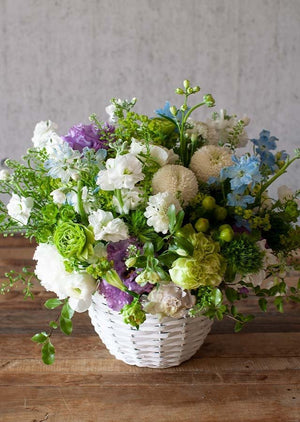
Learn about taboos during the O-Higan period! We'll also cover manners.

Learn About Taboos During the Higan Period! Also Introducing Manners
Higan, observed twice a year in spring and autumn.
Are some of you concerned, wondering, "Are there things I shouldn't do during Higan?" or "I'm unsure about the manners?"
In this article, from a florist's perspective, we will carefully explain everything from the basic meaning and origin of Higan to manners regarding grave visits and offerings, and especially the "taboos" that require attention.
At &YOUKAEN, we offer high-quality flowers that resonate with the important event of Higan.We will also introduce recommended products at the end, so please use them as a reference.
What is Higan?

First, let's deepen our understanding of the event of Higan, starting with its basic information.
What are the history and origins of Higan?
Higan is a unique Japanese culture derived from Buddhism.
Higan refers to the "world of enlightenment," as opposed to "this shore" (this world full of worldly desires).
The vernal and autumnal equinoxes, when the sun rises exactly from the east and sets exactly in the west, are considered times when it's easy to ponder the Western Pure Land, and this period has become established as a time to express gratitude and perform memorial services for ancestors.
About the Higan period and timing
Higan occurs twice a year, in spring and autumn, respectively.
・Spring Higan: The 7-day period, including the vernal equinox as the middle day, plus 3 days before and 3 days after.
・Autumn Higan: The 7-day period, including the autumnal equinox as the middle day, plus 3 days before and 3 days after.
Since the specific dates change each year, it is important to confirm them just beforehand.
What is the meaning and purpose of Higan?
The most important meaning of Higan is to express gratitude to ancestors and perform memorial services.
It is also a precious opportunity for families and relatives to gather and deepen their bonds.
Furthermore, it is also considered a period for practicing the Buddhist teaching of "Rokuharamitsu" (the Six Perfections).
Traditional events held during Higan
During the Higan period, the following traditional events are held:
・Grave visits: Visiting ancestors' graves to clean them and make offerings.
・Cleaning Buddhist altars and preparing offerings: Cleaning the Buddhist altar at home and making offerings.
・Memorial services: In some cases, a priest is invited to hold a memorial service.
Are there any specific foods for Higan?
The most representative offerings for Higan are botamochi and ohagi.
A characteristic feature is that the names change: "botamochi" (named after the peony flower) for spring Higan, and "ohagi" (named after the bush clover flower) for autumn Higan.
There is also a custom of eating "shojin ryori" (devotional cuisine) which does not use animal products such as meat or fish.
Manners to Observe During Higan

To observe Higan smoothly, it is important to know a few basic manners.
What are the precautions for visiting graves?
Grave visits are an important event to show respect to ancestors.
・Attire: You don't need to wear mourning attire. Choose plain clothes in subdued colors that are not too flashy.
・Items to bring: Offerings (flowers, incense, candles, sweets, etc.), cleaning tools (broom, towel, scrub brush, etc.), and prayer beads are essentials.
・Cleaning: First, it is important to carefully clean the tombstone by wiping it clean and pulling out weeds, etc.
・Water in the water bucket: It is customary to return the water from the cemetery's water bucket after use.
What are the precautions when choosing offerings?
While it is fine to choose offerings that the deceased liked, it is important to select items appropriate for a Buddhist altar or grave.
・Five Offerings: Incense (incense sticks), flowers (cut flowers), light (candles), pure water (water), and food/drink (sweets or fruit) are considered important offerings to Buddha and ancestors. Among these, flowers are a precious offering that heals the soul of the deceased and brings peace.
Regarding sweets, those that keep well and are individually wrapped are desirable.
There are also taboo offerings such as meat, fish, and stimulants, which will be explained in detail in the following section.
What should I wear and bring for Higan?
For Higan, it is not necessary to wear mourning attire as you would for a Buddhist service or Obon. Plain clothes that are not too flashy are the basic rule.
For items to bring, making a list of what you need for a grave visit can prevent you from forgetting anything.
Prepare flowers for offerings, incense, candles, a lighter, prayer beads, towels and brushes for cleaning, and garbage bags.
About grave visiting etiquette
Let's also review the basic etiquette for grave visits.
① Upon arrival: Greet the cemetery management office and sometimes borrow a water pail and ladle.
② Grave cleaning: First, carefully clean the tombstone by wiping it clean and removing weeds.
③ Offerings: Place flowers in the flower vase and pour water into the water basin. For sweets and fruits, lay down a sheet of plain paper before offering.
④ Lighting incense: Be careful not to set the tombstone on fire, and if lighting multiple incense sticks, light them one by one carefully.
⑤ Prayer and bowing: Bring your hands together in prayer and bow, expressing gratitude and respect to the deceased.
⑥ Before leaving: It is customary to take offerings home to prevent them from being disturbed by crows, etc. Be mindful not to litter the cemetery.
When visiting another's home during Higan
There are also manners to observe when visiting a relative's or friend's home during Higan.
・Contact them in advance: Avoid sudden visits and always contact them beforehand to confirm their availability.
・Prepare a gift: Bring sweets or flowers, something that can be offered at the Buddhist altar, as a gift.
・About greetings: Instead of saying "My condolences for your loss," choose polite words to mourn the deceased, such as "My deepest sympathies" or "May they rest in peace."
・Do not overstay!: Be mindful of the host's convenience and avoid staying too long.
Taboos Not to Do During Higan

Higan is an important period to express gratitude to ancestors, but sometimes taboos can be committed unconsciously. Let's look at the points that require particular attention.
What are the taboos regarding offerings?
There are items to avoid for offerings.
・Things that evoke killing, such as meat and fish: These should be avoided as shojin ryori (devotional cuisine) is fundamental in Buddhism.
・Stimulants: Strong-smelling items like garlic and chives are generally avoided.
(Even preferences the deceased enjoyed in life, such as alcohol or tobacco, may be inappropriate as offerings for a Buddhist altar.)
・Thorned flowers like roses: These are generally avoided as memorial flowers.
・Poisonous flowers: Flowers with toxic properties, such as narcissus and cluster amaryllis, must never be offered.
・Vining flowers: These are generally avoided due to the image of intertwining.
Regarding flower taboos, florists with specialized knowledge will create the arrangements, so please rest assured. (Thorns will be removed from roses, for example).
Be careful with your choice of words when visiting
The choice of words when visiting during Higan is also important.
・While "Goshushosama desu" (My condolences) is a phrase usable for all mourning occasions, during Higan, it is more appropriate to choose more polite words that commemorate the deceased, such as "Okuyami moshiagemasu" (My deepest sympathies) or "Gomeifuku wo oinori itashimasu" (May they rest in peace).
・Avoid secular greetings like "Taihen deshita ne" (That must have been tough) or "Ogenki desu ka" (How are you?), and choose words that show respect for the deceased.
・Depending on the sect, specific choice of words may require caution, so if you are unsure, it is advisable to confirm beforehand.
Avoid excessive decoration
Higan is primarily about frugality and simplicity.
Therefore, overly flashy decorations or excessive offerings may be inappropriate.
Remember that the feeling of mourning the deceased is what matters most.
Paying attention to your tone of voice is also important
It is good manners not to speak loudly or make noise in places with graves or Buddhist altars.
To show respect for the deceased and ancestors, make an effort to speak in a calm and quiet voice. It is also important to teach children to be quiet.
The Religious Significance of Higan

Higan is not just a custom; it carries deep religious significance. Understanding its background might change how you approach Higan.
Higan in Buddhism
In Buddhism, Higan refers to the "world of enlightenment". The teaching of Buddhism is to strive to cross from This Shore (the present world full of worldly desires) to The Other Shore (Higan).
During the spring and autumn equinoxes, when the sun rises exactly from the east and sets exactly in the west, it is easy to contemplate the Western Pure Land, and this custom is believed to have originated from this.
Higan as Ancestor Worship
Higan is an important opportunity to express gratitude to ancestors and perform "Tsuizen Kuyo" (posthumous good deeds for the deceased).
Tsuizen Kuyo is a teaching that states by performing good deeds, the merit of those deeds reaches the deceased.
Through memorial services, it is also a period to pray for the repose of the deceased and to reflect on one's own actions.
The relationship between Higan and the Six Perfections
The Higan period is also a time to practice the "Rokuharamitsu" (Six Perfections) as taught in Buddhism.
① Fuse (charity): Giving to others without expecting anything in return.
② Jikai (precepts): Observing Buddhist precepts and keeping the mind pure.
③ Ninniku (forbearance): Enduring suffering and difficulties.
④ Shojin (diligence): Continuing to strive towards a goal.
⑤ Zenjo (meditation): Calming the mind and increasing concentration.
⑥ Chie (wisdom): Discerning the truth.
Through these actions, one aims to reach Higan, the world of enlightenment.
The faith embodied in Higan
Higan is not merely a custom; at its core lies a faith that allows one to feel a connection with ancestors and express gratitude.
It is also an opportunity to consider the preciousness of life and the transience of all things, and it is deeply involved in the Japanese view of life and death.
The significance of Higan in modern times
In busy modern society, Higan serves as a precious time to pause, calm one's mind, and reconfirm family bonds.
It also holds the significance of transmitting traditions across generations, making it a valuable opportunity for families to remember their ancestors.
Let's Offer Flowers for Higan

As an offering for Higan, flowers are perfect for conveying gratitude and respect to the deceased. We, "&YOUKAEN", will help you give form to those important feelings.
The most popular is the "Offering Flower Arrangement"

The Offering Flower Arrangement is arranged in a basket or vase, making it very easy to display as is, which is the main reason for its popularity.
There's no need to change the water; regular watering is sufficient.
It is also highly decorative and visually appealing, making it a popular gift choice.
During the Higan season, arrangements of a size suitable for decorating a Buddhist altar are particularly popular.

Seasonal Offering Arrangement
¥9,900-
The most popular gift is the "Ready-to-Display Bouquet"

The "Ready-to-Display Bouquet" is particularly popular as a gift for relatives or friends who live far away.
Even if you want to send flowers but don't know if the recipient has a vase, it's okay!
It arrives in a simple container or immersed in Eco Jelly to keep it watered, so it can be displayed as is even without a vase. You can simply place it down.
The thoughtfulness of saving the recipient the trouble and its good longevity are also appreciated.

Ready to Display! Seasonal Omakase Bouquet
¥7,700-
For those who have a vase, "Offering Bouquet"

If the recipient has a vase, an "offering bouquet" is also a good choice.
A bouquet is a simple flower gift that can be freely arranged in a vase. You can also choose to send the flowers and colors the deceased loved.
Being able to adjust the volume according to your budget is also an attractive feature.
"&YOUKAEN" sells offering bouquets of various price ranges and designs, so you can choose according to the size of the Buddhist altar or the ambiance of the room.

Blue and White Offering Flower Bouquet
¥9,570-
Summary

We hope this has helped you understand the "things you shouldn't do during Higan" and the etiquette surrounding it.
Higan is a precious opportunity to express gratitude and offer prayers to our ancestors, while also deepening family bonds.
This article explained everything from the meaning and origin of Higan, to tomb-visiting etiquette, choosing offerings, and especially the "taboos" to be aware of.
Understanding the manners and taboos, and offering heartfelt tributes, is crucial for showing respect to the deceased.
Among these, flowers are ideal offerings that heal and bring peace to the soul of the deceased. Please do decorate with flowers during Higan.
"&YOUKAEN" offers a wide selection of high-quality floral gifts suitable for the solemn occasion of Higan.
We are here to help you bring your cherished feelings to life. We also accept consultations regarding custom orders and delivery, so please feel free to contact us.
Jul 21, 2025